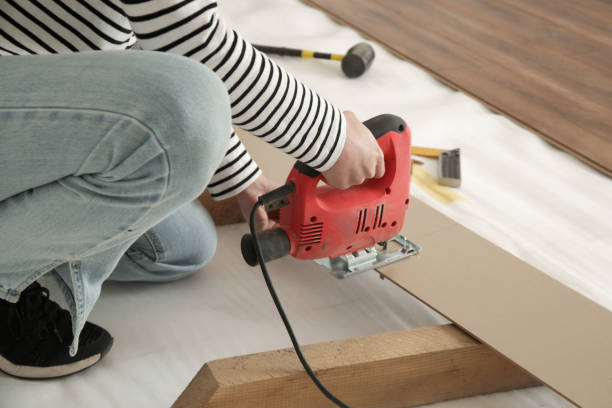

Laminate flooring has come a long way from the thin, obviously fake product that gave it a questionable reputation in its early years. Today’s premium laminate is visually impressive — realistic wood grain textures, varied plank lengths that break up the repeating pattern problem of older products, and finishes that genuinely require a second look to distinguish from the real thing. At a fraction of the cost of hardwood, it makes quality-looking floors accessible for spaces and budgets where solid wood doesn’t make sense.
But the quality of the product is only part of the equation. Professional laminate flooring installation is what makes the difference between a floor that looks great and performs reliably for years and one that shows its flaws within months. Laminate installed correctly is a genuinely good floor. Laminate installed carelessly is a floor you’ll want to replace soon.
What Makes Modern Laminate Worth Considering
The construction of quality laminate flooring consists of several layers: a wear layer that provides scratch and stain resistance, a high-resolution photographic layer that creates the visual appearance of wood or stone, a core layer (typically HDF — high density fiberboard) that provides stability, and a backing layer. The thickness of the wear layer and the quality of the core determine how the floor performs over time.
Premium laminate products now include attached underlayment for better sound performance and comfort underfoot, textured surfaces that realistically mimic the feel of wood grain, and water-resistant or waterproof cores that significantly expand where laminate can be appropriately installed. These developments have made laminate a legitimate choice for kitchens and, in some cases, bathrooms — applications where older laminate products weren’t appropriate.
Subfloor Requirements for Laminate
Laminate flooring is less forgiving of subfloor imperfections than some people expect. Because it’s a floating floor — meaning it’s not fastened to the subfloor but clicks together and sits on top of it — it follows the contours of whatever it’s installed on. A subfloor that has humps or dips exceeding the manufacturer’s flatness specification will create a finished floor that flexes, bounces, or develops stress points at the joints.
Professional laminate flooring installation starts with a flatness check across the entire installation area. High spots get ground down. Low spots get filled with floor leveling compound and allowed to cure before installation begins. This prep work adds time to the job, but it’s the reason a professionally installed laminate floor feels solid and stable rather than hollow and flexible.
Expansion Gaps: The Detail That Amateur Installations Get Wrong
Laminate flooring expands and contracts with changes in temperature and humidity. This is just physics — most materials do. The expansion gap — typically around 10mm — left between the flooring and all walls and vertical objects provides the space the floor needs to move without buckling.
Skipping or inadequately maintaining this gap is one of the most common installation errors, and the consequences are visible and permanent. Floors that have been installed tight to walls buckle in warm weather, creating ridges that won’t go back down once the floor has been stressed. The only fix is removing and reinstalling the floor with proper gaps. Professionals get this right the first time.
Underlayment Selection for Comfort and Performance
The underlayment beneath laminate flooring does several things: it cushions the floor for better comfort underfoot, provides a slight sound reduction, helps the floor float smoothly over minor subfloor irregularities, and in some cases provides a vapor barrier over concrete subfloors. Choosing the right underlayment depends on the subfloor type and the specific laminate product.
Some laminate products come with underlayment pre-attached, which simplifies installation. Others require a separate underlayment layer. Using a second layer of underlayment on a product that already has it attached creates too much cushion and can cause joint stress and gapping over time. Again — these are the details that professional installers know and that make the installation actually work correctly.
For contemporary residential spaces where laminate flooring is the right choice, Cruz Home Construction delivers laminate flooring installation that maximizes what the material can do — installed right, looking great, and built to last.